Drum beat patterns in PDF format offer accessible learning, blending customer stories, events, and resources like GitHub Skills for enhanced musical growth.
What are Drum Beat Patterns?
Drum beat patterns are the foundational rhythmic structures that drive music across countless genres. They represent a sequence of hits on various drum set components – snare, bass drum, hi-hat, toms, and cymbals – arranged over a specific time signature. These patterns aren’t just random hits; they’re carefully constructed arrangements designed to create groove, feel, and musical expression.
Understanding these patterns is crucial for any drummer, from beginners to professionals. They provide the building blocks for improvisation, song arrangement, and overall musicality. PDFs serve as a convenient way to access and study these patterns, offering a portable and easily shareable format for learning and practice. They often include notation, timing suggestions, and even stylistic guidance.
Why Use PDF Format for Drum Beats?
PDFs offer unparalleled convenience for accessing and utilizing drum beat patterns. Their portability allows drummers to practice anywhere – at home, on the road, or during rehearsals – without needing a computer or internet connection. The format ensures consistent visual presentation across different devices, maintaining clarity of notation crucial for accurate learning.
Furthermore, PDFs are easily shareable, facilitating collaboration between drummers and instructors. Resources like ebooks, reports, and even business insights are often distributed as PDFs, making them a standard for musical education. Combined with platforms like GitHub Skills and customer stories, PDFs become part of a larger learning ecosystem, enhancing skill development and musical understanding.
Basic Drum Notation & Reading
Understanding drum notation is key to interpreting PDF beat patterns, unlocking rhythmic possibilities and enabling drummers to translate visual cues into sound.
Understanding Standard Drum Notation
Decoding drum notation within PDFs is fundamental for any aspiring drummer. The standard system utilizes a staff with five lines and four spaces, assigning each drum or cymbal a specific location. The bass drum typically resides on the bottom space, while the snare drum occupies the third space.
Hi-hats are often represented with an “x” above the top line, and cymbals have varying placements. Note values – whole, half, quarter, eighth, and sixteenth notes – dictate the duration of each hit. Rests indicate silence.
Understanding these symbols allows you to accurately interpret PDF drum beat patterns, translating the written music into precise rhythmic performances. Familiarity with these basics unlocks a world of musical possibilities, enabling you to learn and play a vast library of beats.
Key Elements in Drum Sheet Music (PDFs)
Drum sheet music in PDF format isn’t just about notes; it’s a language of rhythm. Beyond the basic note values, look for time signatures – like 4/4 – indicating beats per measure. Bar lines separate these measures, creating a visual structure. Repeat signs simplify complex patterns, saving space within the PDF.
Dynamic markings (p for piano, f for forte) show volume levels, adding expression. Accent marks (>) emphasize specific beats. Ghost notes, often smaller and lighter, add subtle nuances.
Understanding these elements within a PDF allows for accurate interpretation and expressive playing. Pay attention to any included instructions or symbols, as they provide crucial context for the drum beat pattern.
Essential Drum Beat Patterns for Beginners
Beginner drum beat PDFs unlock foundational rhythms, offering accessible practice through simple rock, pop, and funk grooves for aspiring drummers.
Basic Rock Beat (4/4 Time)
The foundational 4/4 rock beat, readily available in numerous drum beat PDFs, is the cornerstone of countless songs. Typically, it features a consistent kick drum on beats one and three, a snare drum on beats two and four – creating the backbeat – and a closed hi-hat pattern played on every eighth note.
PDF resources often visually represent this as:
- Kick: X . X .
- Snare: . X . X
- Hi-Hat: x x x x x x x x
Where ‘X’ denotes a hit and ‘.’ represents silence. Mastering this beat, through consistent practice with PDF drum sheets, builds essential coordination and timing. Many PDFs include variations, introducing subtle changes to the hi-hat or adding ghost notes to the snare, offering a stepping stone to more complex rhythms. This simple yet powerful beat is the perfect starting point for any drummer.
Simple Pop Beat
The quintessential pop drum beat, frequently found within drum beat PDF collections, prioritizes a clean, driving rhythm. It generally maintains the 4/4 time signature, but often simplifies the hi-hat pattern compared to rock. A common variation features the kick drum on beats one and three, snare on two and four, and a quarter-note hi-hat pattern – one hit per beat.
Visually, a PDF might show:
- Kick: X . X .
- Snare: . X . X
- Hi-Hat: x . x .
This creates a less busy feel, allowing vocals and melodies to shine. PDF drum sheets often showcase subtle variations, like adding a ghost note on the snare or opening the hi-hat on certain beats. Practicing with these PDFs develops a solid foundation for playing a wide range of pop music, emphasizing groove and pocket.

Fundamental Funk Groove
Funk drum beats, readily available in drum beat PDF resources, are characterized by syncopation and a strong emphasis on the “one” and the “three”. Unlike straight rock or pop, funk utilizes ghost notes – quiet, subtle snare hits – to create a complex, rhythmic texture. A basic funk groove often features the kick drum playing off-beats, adding to the infectious feel.
A typical PDF representation might include:
- Kick: X . . . X . ; .
- Snare: . X . g . X . g
- Hi-Hat: x x x x x x x x
(where ‘g’ represents a ghost note). Mastering these patterns from PDFs requires precise timing and dynamic control. Funk drumming isn’t about power; it’s about feel and creating a pocket that makes people want to move. These PDFs are invaluable for developing that crucial rhythmic sensibility.
Intermediate Drum Beat Patterns
Drum beat PDFs at this level introduce eighth notes, ghost notes, and Latin rhythms, building upon foundational skills for rhythmic complexity and expression.
Rock Variation with Eighth Notes
Expanding beyond the basic rock beat, this pattern utilizes eighth notes on the hi-hat, creating a more driving and energetic feel. Drum beat PDFs showcasing this variation often include notation emphasizing the subtle differences in timing and dynamics.
The core structure remains similar – kick on beats one and three, snare on beats two and four – but the consistent eighth-note pulse adds a layer of complexity. Practicing with a metronome is crucial for maintaining accuracy.
Many PDF resources will demonstrate variations within this pattern, such as adding accents or incorporating fills. These PDFs frequently cater to intermediate drummers seeking to refine their timing and groove. Focus on clean execution and consistent volume control for optimal results. Mastering this builds a solid foundation for more advanced rock drumming techniques.
Funk Beat with Ghost Notes
Funk drumming is renowned for its syncopation and subtle nuances, and ghost notes are central to achieving that feel. Drum beat PDFs dedicated to funk often highlight these quiet, almost imperceptible snare drum strokes played between the backbeats.
These ghost notes aren’t about volume; they’re about rhythmic texture. They add a “pocket” to the groove, making it feel more relaxed and infectious. PDFs will typically show ghost notes as smaller noteheads or with specific dynamic markings.
Beginners should practice slowly, focusing on consistent placement and a light touch. Combining ghost notes with a solid kick and hi-hat pattern creates a compelling funk foundation. Exploring PDF libraries will reveal diverse funk variations, building rhythmic vocabulary and improvisational skills.
Latin-Inspired Beat (Samba/Bossa Nova)
Latin rhythms, like Samba and Bossa Nova, introduce a unique feel to drumming, often showcased in specialized drum beat PDFs. These patterns emphasize intricate percussion and a flowing, danceable groove. PDFs will typically detail the clave pattern – the rhythmic foundation – and how it interacts with the drum kit.
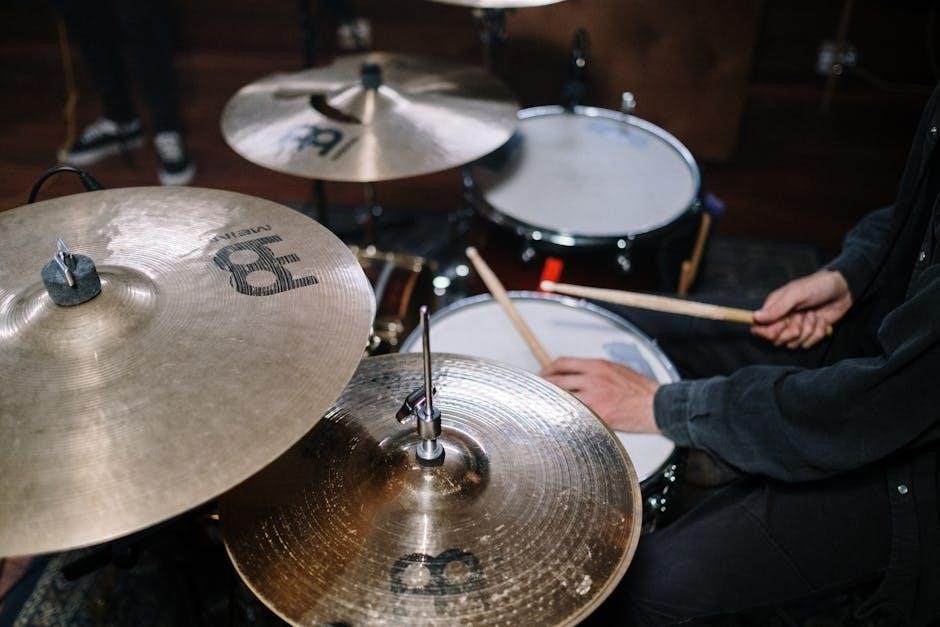
Common elements include a rim click or cross-stick on beats two and four, a subtle hi-hat pattern, and a focus on the ride cymbal for a shimmering texture. PDFs often include variations for different tempos and levels of complexity.
Mastering these beats requires careful listening and attention to detail. Utilizing PDF resources alongside audio examples is crucial for internalizing the authentic Latin feel and expanding rhythmic versatility.
Advanced Drum Beat Patterns & Techniques
Advanced PDF drum beats explore polyrhythms, double bass techniques, and odd time signatures, pushing rhythmic boundaries for skilled drummers seeking complex challenges.
Polyrhythms and Complex Time Signatures
Delving into polyrhythms within drum beat PDFs unlocks a world of rhythmic sophistication. These patterns superimpose different rhythmic groupings – for example, playing three notes over two beats (3:2) – creating a captivatingly complex texture. PDFs allow for clear visual representation of these intricate arrangements, aiding comprehension and practice.
Beyond polyrhythms, exploring complex time signatures like 7/8 or 5/4, readily available in downloadable PDF format, challenges drummers to redefine their sense of pulse. These signatures deviate from the common 4/4, demanding precise counting and a nuanced feel. PDFs often include detailed breakdowns, highlighting the accent patterns and subdivisions within these unusual meters. Mastering these concepts elevates rhythmic creativity and expands a drummer’s versatility, offering a deeper understanding of musical time.
Double Bass Drum Patterns
Double bass drum patterns, easily accessed through drum beat PDFs, represent a cornerstone of modern drumming, particularly in genres like metal and hard rock. These PDFs visually demonstrate the coordination required to execute rapid, alternating bass drum strokes, enhancing speed and power. They often showcase various techniques, including heel-toe and swivel methods, with clear notation for precise timing.
PDF resources frequently offer progressive exercises, starting with simple double bass lines and gradually increasing in complexity. This structured approach allows drummers to build stamina and control. Furthermore, PDFs can present double bass patterns within full drum beat arrangements, illustrating how they integrate with other drum elements. Utilizing these resources fosters rhythmic precision and unlocks a dynamic, driving force within drumming performance.
Odd-Time Signature Grooves (e.g., 7/8, 5/4)
Drum beat PDFs specializing in odd-time signatures – like 7/8 and 5/4 – unlock a world of rhythmic complexity beyond standard 4/4 time. These resources visually break down the unique groupings of beats, aiding comprehension and execution. PDFs often present these grooves with clear counts and subdivisions, crucial for navigating the unconventional feel.
Finding PDFs with exercises that emphasize internalizing the pulse is key. They frequently showcase how to apply common drum rudiments within these time signatures, fostering creativity and improvisation. Exploring odd-time grooves through PDF notation expands a drummer’s rhythmic vocabulary and allows for more nuanced and progressive musical expression, moving beyond conventional structures.
Resources for Drum Beat PDFs
Numerous online platforms provide drum beat PDFs, ranging from free websites offering basic patterns to paid libraries with extensive collections and detailed courses.
Popular Websites Offering Free Drum Beat PDFs
Several websites cater to drummers seeking free drum beat PDFs, providing a fantastic starting point for learning and practice. Websites like Drum Beats Online and FreeDrumLessons.com offer a diverse range of patterns, from basic rock grooves to more complex funk and jazz rhythms.
Mikeslessons.com is another valuable resource, featuring a substantial library of downloadable PDF drum charts. These sites often categorize beats by genre and skill level, making it easy to find suitable material. Additionally, many drumming communities and forums share free PDF resources amongst their members.
Remember to always check the licensing terms before using any downloaded material, ensuring it’s permissible for your intended purpose – whether it’s personal practice or performance. These free resources are excellent for building a foundational repertoire and exploring different styles.
Paid PDF Drum Beat Libraries & Courses
For drummers desiring more structured learning and extensive content, paid PDF libraries and courses offer significant value. Websites like Drumeo provide comprehensive courses with accompanying PDF transcriptions of beats and exercises, often featuring video instruction. Hudson Music offers a vast catalog of drum books available as PDFs, covering various styles and techniques.
Drum Beats Complete is another option, boasting a large library of professionally transcribed drum beats across numerous genres. These resources typically offer higher-quality notation, detailed explanations, and progressive learning paths. Investing in paid materials can accelerate your development and provide access to exclusive content not found on free platforms.
Consider your learning style and goals when choosing a paid option, as some focus on specific genres or skill levels.
Creating Your Own Drum Beat PDFs (Software Options)
For drummers who wish to personalize their learning or share their creations, several software options facilitate PDF creation. MuseScore, a free and open-source notation software, allows for detailed drum beat composition and exporting to PDF. Sibelius and Finale are industry-standard notation programs offering advanced features, though they come with a cost.
Alternatively, dedicated drumming software like Logic Pro X or Ableton Live can be used to create beats and then exported as PDFs via a separate notation plugin or by screenshotting and compiling into a document. These tools offer flexibility and control over every aspect of your drum beat notation, enabling customized learning materials.
Experiment to find the software that best suits your needs and technical skill level.
Tips for Practicing with Drum Beat PDFs
Effective practice with drum beat PDFs requires consistent metronome use and a gradual speed increase, building accuracy and rhythm over time.
Using a Metronome
A metronome is your best friend when working with drum beat PDFs. It provides a consistent pulse, crucial for developing accurate timing and internalizing the rhythm of the patterns. Start slowly, selecting a tempo where you can comfortably play the beat without rushing or dragging.
Focus on aligning each stroke precisely with the metronome click. Gradually increase the tempo as your accuracy improves. Don’t be afraid to slow down again if you encounter difficulties; The goal isn’t speed, but precision.
Experiment with different metronome subdivisions – quarter notes, eighth notes, and even sixteenth notes – to challenge yourself and deepen your understanding of the rhythm. Utilizing a metronome consistently will dramatically improve your drumming skills when practicing with PDF drum beats.
Slow Practice & Gradual Speed Increase
Mastering drum beat PDFs demands patience and a strategic approach. Begin by practicing each pattern at a very slow tempo, focusing on clean execution and proper technique. Resist the urge to rush; accuracy is paramount at this stage. Ensure each note is distinct and evenly spaced.
Once comfortable, incrementally increase the tempo – perhaps by 5-10 BPM at a time. Continue to prioritize precision over speed. If you stumble, immediately slow down to regain control.
Consistent, gradual progression builds muscle memory and solidifies your understanding of the rhythm. This method, applied to PDF drum beats, fosters long-term improvement and prevents the development of bad habits.