
Major and Minor Piano Scales: A Comprehensive Guide (PDF Focus)
Dive into the world of piano mastery! This guide focuses on readily available PDF resources for learning major and minor scales,
enhancing your musical understanding and technique. Explore visual aids like gemb0y’s scale charts, and unlock the power of the circle of fifths.
Piano scales are the fundamental building blocks of music, essential for developing technique, ear training, and improvisation skills. Understanding both major and minor scales is crucial for any pianist, regardless of genre. This guide, with a focus on PDF resources, will provide a structured approach to learning these vital musical components.
Scales aren’t merely exercises; they unlock harmonic understanding and allow you to navigate the keyboard with confidence. Many pianists and producers utilize visual aids, like those found on platforms such as GitHub (gemb0y/piano-scales), to quickly identify scale patterns. These resources often come in convenient PDF format for easy printing and practice.
We’ll explore the theoretical foundations of major and minor scales, alongside practical application through readily available PDF charts and diagrams. The journey begins with grasping the core concepts, then progresses to fingerings, common scales, and ultimately, utilizing PDF materials effectively to accelerate your learning. Prepare to unlock a deeper connection to the piano!
What are Major Scales?
Major scales are the foundation of much Western music, often described as sounding bright and cheerful. They are constructed using a specific pattern of whole and half steps, creating a characteristic sonic quality. Understanding this pattern is key to mastering the piano, and thankfully, numerous PDF resources visually demonstrate this structure.

These scales consist of seven notes, with the eighth note being an octave of the first. Learning to identify and play major scales fluently is essential for understanding chords, key signatures, and musical form. Many introductory piano PDF charts begin with major scales due to their relative simplicity and prevalence.
Resources like those referenced (gemb0y/piano-scales) often present major scales in a clear, visual format, making them accessible to learners of all levels. Utilizing these PDF aids allows for focused practice and quick reference. We will delve into the specific structure and fingerings of major scales, preparing you to utilize available PDF practice materials effectively.
The Structure of a Major Scale
A major scale’s defining characteristic is its specific interval pattern: Whole-Whole-Half-Whole-Whole-Whole-Half. This sequence of whole (W) and half (H) steps dictates the arrangement of notes within the scale. Visualizing this pattern is significantly aided by PDF charts, which often color-code or highlight the intervals.
Starting on any note, applying this W-W-H-W-W-W-H formula generates the corresponding major scale. For example, the C major scale (C-D-E-F-G-A-B-C) has no sharps or flats, making it a common starting point for beginners – and a frequent feature in introductory PDF guides.
Understanding this structure isn’t just about memorization; it’s about internalizing the relationship between the notes. Many PDF resources don’t just present the scales, but also explain the underlying theory. This allows you to build scales from scratch, rather than relying solely on memorized patterns. Effective PDF practice materials will emphasize this conceptual understanding alongside rote learning.
Major Scale Fingerings on Piano
Proper fingering is crucial for smooth, efficient scale playing. PDF charts dedicated to major scales often include suggested fingerings alongside the notes, typically using numbers 1-5 to represent each finger (thumb to pinky). Consistent fingering builds muscle memory and prevents awkward transitions.

The standard fingering for C major, for instance, is 1-2-3-1-2-3-4-5 ascending, and reversed descending. However, fingerings shift slightly for other scales to optimize playability. High-quality PDF resources will demonstrate these variations clearly.
Many PDF guides emphasize the importance of crossing the thumb under the hand – a technique essential for navigating the keyboard efficiently. Look for charts that visually illustrate these crossings. Beginner PDFs often start with one-octave scales, gradually introducing larger ranges and more complex fingerings as proficiency increases. Practicing with a PDF that highlights correct fingering is paramount for developing good technique and avoiding bad habits.
Common Major Scales (C, G, D, A, E, F#)
Mastering a select group of major scales provides a solid foundation for piano playing. PDF resources frequently prioritize C, G, D, A, E, and F# major as essential starting points. C major, with no sharps or flats, is often the first scale learned, serving as a reference point.
PDF charts dedicated to these scales will typically display the notes, fingerings, and sometimes even harmonic context. G major introduces the first sharp (F#), while D major adds two (F# and C#). A major has three sharps, E major has four, and F# major boasts six sharps, progressively increasing the complexity.
Many downloadable PDFs offer these scales in multiple octaves, encouraging keyboard exploration. Utilizing PDFs allows for focused practice, enabling musicians to internalize the patterns and build fluency. Look for PDFs that include both ascending and descending patterns, and consider those with accompanying exercises to reinforce learning. Consistent practice with these common scales, guided by PDF resources, accelerates progress.
What are Minor Scales?
PDF resources on piano scales invariably dedicate significant space to minor scales, recognizing their crucial role in musical expression. Unlike major scales, which generally evoke feelings of happiness and stability, minor scales often convey sadness, tension, or introspection. Understanding minor scales is vital for interpreting and performing a vast repertoire of music.
However, minor scales aren’t monolithic; they come in three primary forms: natural, harmonic, and melodic. PDF charts will often present all three variations side-by-side for easy comparison. These variations arise from alterations to specific notes within the scale, impacting its characteristic sound.
Many PDF guides emphasize that minor scales are closely related to their relative major scales (discussed later). A PDF focusing on scale relationships will illustrate this connection, aiding in memorization and comprehension. Finding a comprehensive PDF that clearly defines each type of minor scale, with accompanying fingerings, is key to effective learning. Don’t underestimate the power of visual PDF aids!
Types of Minor Scales: Natural, Harmonic, Melodic
PDF guides dedicated to piano scales consistently detail the three forms of minor: natural, harmonic, and melodic. The natural minor scale is the most basic, derived directly from the major scale’s relative minor. PDF charts often present it as the foundation for understanding the others.
The harmonic minor scale introduces a raised 7th degree, creating a stronger pull towards the tonic and a distinct harmonic flavor. PDF resources highlight this alteration and its impact on chord progressions. This raised 7th is crucial for dominant chords in minor keys.
Finally, the melodic minor scale differs ascending and descending. Ascending, it raises both the 6th and 7th degrees, smoothing out the intervalic leaps. Descending, it reverts to the natural minor form. PDFs often use separate diagrams for each direction. A good PDF will explain why these alterations exist, not just what they are. Locating a PDF with clear visual representations of each scale type is paramount for effective practice.
Natural Minor Scale Explained
The natural minor scale, frequently detailed in piano scale PDFs, is the simplest form of the minor scale. It’s constructed by taking the major scale and lowering the 3rd, 6th, and 7th degrees. Many PDF resources emphasize its direct relationship to its relative major – for example, A natural minor is the relative minor of C major.
PDF charts often visually demonstrate this relationship, showing the shared notes and the altered ones. Understanding this connection simplifies memorization. The interval pattern is Whole-Half-Whole-Whole-Half-Whole-Whole. A comprehensive PDF will include fingerings for various octaves.
Practicing the natural minor scale, as outlined in PDF exercises, builds a foundation for understanding more complex minor scales. It’s commonly used in folk music and provides a melancholic, introspective sound. Look for PDFs that offer practice tips, such as starting slowly and focusing on evenness of tone. A well-designed PDF will also indicate the key signature, making sight-reading easier.
Harmonic Minor Scale Explained
The harmonic minor scale, a crucial element in piano study often found in detailed PDF guides, builds upon the natural minor by raising the 7th degree. This alteration creates a leading tone, strongly pulling towards the tonic, and is a cornerstone of classical harmony. PDF resources frequently highlight this characteristic interval.
PDF charts visually illustrate the difference between natural and harmonic minor, emphasizing the sharpened 7th. The interval pattern becomes Whole-Half-Whole-Whole-Half-Whole-and-a-Half. This creates a distinctive sound, often described as dramatic or exotic. Many PDFs include fingerings tailored to the scale’s unique intervals.
Practice PDFs will often focus on navigating the augmented second between the 6th and 7th degrees, a common challenge for beginners. Understanding the harmonic minor is vital for composing and improvising in a minor key. Look for PDFs that demonstrate chord progressions built from the harmonic minor scale, solidifying its harmonic function. A good PDF will also show the key signature.
Melodic Minor Scale Explained
The melodic minor scale, frequently detailed in comprehensive piano scale PDFs, presents a unique characteristic: differing ascending and descending forms. Ascending, it raises both the 6th and 7th degrees, creating a smoother, more melodic sound, hence the name. PDF resources emphasize this crucial distinction.
PDF charts clearly demonstrate the ascending pattern – Whole-Half-Whole-Whole-Whole-Whole-Half – and the descending pattern, which reverts to the natural minor (Whole-Half-Whole-Whole-Half-Whole-Whole). This dual nature is often highlighted with separate fingerings in practice PDFs.
Many PDF guides explain the historical reasoning behind this alteration, aiming to avoid the awkward augmented second found in the harmonic minor. Mastering the melodic minor requires diligent practice of both forms, often presented in PDF exercises. Look for PDFs that illustrate how the melodic minor resolves to chords, showcasing its harmonic versatility. Understanding the melodic minor is key to advanced piano technique and musical expression, and a good PDF will show the key signature.
Minor Scale Fingerings on Piano

Effective minor scale practice, as detailed in numerous piano scale PDFs, hinges on mastering correct fingerings. PDF resources typically present fingerings tailored to each minor scale type – natural, harmonic, and melodic – recognizing their unique intervallic structures. Consistent fingering builds muscle memory and facilitates smoother transitions.
PDF charts often illustrate fingerings starting with the thumb (1) on the root note, prioritizing a comfortable hand position. Pay close attention to thumb tucks and finger crossings, frequently emphasized in advanced PDF exercises. Different PDFs may offer alternative fingerings, catering to varying hand sizes and preferences.
Beginner PDFs usually focus on one-octave scales, gradually introducing two-octave and beyond as proficiency grows. Look for PDFs that include fingering diagrams alongside the musical notation. Practicing slowly and deliberately, referencing the PDF, is crucial. Remember, consistent application of correct fingerings, guided by a quality PDF, unlocks fluency and prevents technical limitations. Many PDFs also include suggested practice tempos.
Common Minor Scales (A, E, B, F#, C#, G#)
When utilizing piano scale PDFs, focusing on frequently encountered minor scales accelerates learning. A, E, B, F#, C#, and G# minor are foundational, appearing often in repertoire and exercises found within comprehensive PDF collections. These scales, presented clearly in PDF format, allow for focused practice.
PDF resources often group these scales by key signature, aiding memorization. A natural minor (no sharps or flats) is a common starting point, while scales like F# and C# minor, with multiple sharps, demand careful attention to accidentals – a detail well-illustrated in PDF charts.
Many PDFs provide all three forms (natural, harmonic, melodic) for each scale, highlighting the subtle but crucial differences. Downloadable PDFs frequently include exercises specifically designed around these scales, building technique and musicality. Practicing these common minor scales, using readily available PDFs, establishes a strong foundation for tackling more complex pieces and improvisations. Remember to check PDF update dates for accuracy!
Relationship Between Major and Minor Scales (Relative Minor/Major)

Understanding the relationship between major and minor scales is crucial for pianists, and PDF resources excel at visually demonstrating this connection. The concept of relative minor/major – where each major key has a corresponding minor key sharing the same key signature – is often highlighted in piano scale PDF charts.
For example, a PDF might show C major alongside A minor, both utilizing no sharps or flats. This parallel presentation aids in recognizing patterns and transposing between keys. Many PDFs include exercises that explicitly practice moving between relative major and minor scales, strengthening harmonic awareness.
PDF guides often illustrate how the minor scale is derived from the major scale (starting on the 6th degree). Visual PDF diagrams can clearly show the intervalic differences. Utilizing these PDF tools allows for a deeper comprehension of key relationships, improving improvisation skills and musical interpretation. Finding a well-structured PDF simplifies grasping this fundamental concept, accelerating your piano journey.
The Circle of Fifths and Piano Scales
The Circle of Fifths is an invaluable tool for pianists learning scales, and many PDF resources leverage it to illustrate key relationships. PDF charts frequently depict the circle, visually organizing all major and minor keys. This allows for quick identification of key signatures and related scales.
A good piano scale PDF will demonstrate how moving clockwise around the circle adds a sharp to the key signature, while counter-clockwise adds a flat. This is particularly helpful when learning scales in less familiar keys. PDFs often include exercises that involve navigating the circle, practicing scales in adjacent keys.
Furthermore, PDF guides can show how the circle highlights parallel major and minor keys, and their relative counterparts. Understanding the circle’s structure, as presented in these PDFs, simplifies memorization and enhances your ability to transpose. Printable PDF versions of the circle are readily available, providing a constant reference during practice sessions, solidifying your understanding.
Visual Aids: Piano Scale Charts & Diagrams (PDF Resources)
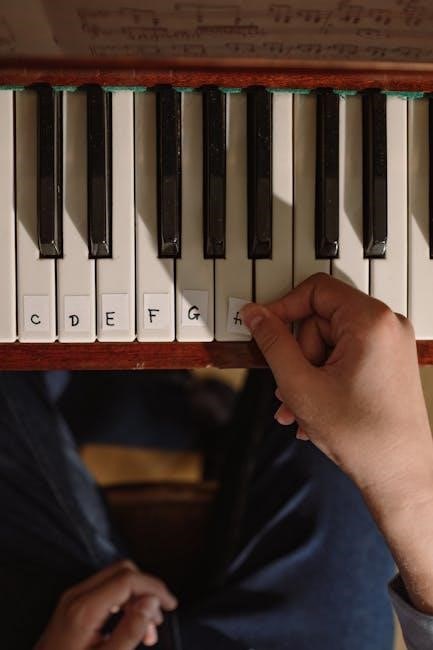
PDF resources excel at providing clear visual aids for piano scales. Charts and diagrams are crucial for understanding scale patterns and fingerings, especially for beginners. Many freely available PDFs showcase keyboard diagrams with scales highlighted, making it easy to visualize note positions.
These PDF charts often color-code scales, differentiating between major and minor, and highlighting accidentals. Diagrams illustrating fingerings are also common, guiding proper hand positioning. Resources like gemb0y’s “piano-scales” (as found online) offer visually appealing and informative scale maps in PDF format.
Advanced PDFs may include multiple scale variations – natural, harmonic, and melodic minor – all visually represented. Look for PDFs that include both grand staff notation and keyboard diagrams for a comprehensive learning experience. Printable PDF charts allow you to keep these visual references close during practice, accelerating your scale mastery and musical comprehension.
Finding Free Major & Minor Scale PDF Charts
Locating free PDF charts for major and minor scales is surprisingly accessible online. A simple web search using keywords like “piano scales PDF,” “major scale chart PDF,” or “minor scale diagrams PDF” yields numerous results. Websites dedicated to music education frequently offer downloadable resources.
GitHub, as exemplified by gemb0y’s “piano-scales” repository, is a valuable source. While direct access to the latest commit might be temporarily unavailable, similar repositories often exist. Music theory websites and online piano lesson platforms also provide free PDF scale charts as supplementary materials.
Be mindful of website credibility when downloading PDFs; Look for resources from established music educators or institutions. Many PDFs are available in various formats, catering to different skill levels – from beginner-friendly charts to more complex diagrams for advanced players. Remember to preview the PDF before downloading to ensure it meets your needs and learning style.
PDF Resources for Scale Practice (Beginner to Advanced)
Numerous PDF resources cater to all piano skill levels, facilitating effective scale practice. Beginners benefit from charts displaying scales with fingerings, often color-coded for clarity. These introductory PDFs typically focus on C major, G major, and A minor, providing a solid foundation.
Intermediate players can utilize PDFs that include scales across more keys, incorporating harmonic and melodic minor variations. Resources detailing scale patterns and arpeggios are also valuable. Advanced pianists can find PDFs presenting complex scales, such as double-sharp and double-flat scales, alongside challenging exercises.
Websites like musictheory.net and teoria.com offer interactive exercises alongside downloadable PDFs. GitHub repositories, like the one by gemb0y, often contain comprehensive scale diagrams. Look for PDFs that include practice tips, common mistakes to avoid, and suggestions for incorporating scales into musical pieces. Consistent practice with these resources will significantly improve your technique and musicality.
Using PDF Charts Effectively for Learning
PDF scale charts are invaluable tools, but maximizing their effectiveness requires a strategic approach. Begin by printing charts in a clear, readable size. Actively annotate PDFs – highlight fingerings, circle accidentals, and mark challenging sections. Don’t just passively observe; physically trace the scale patterns with your finger on the chart to reinforce muscle memory.
Utilize color-coding to differentiate between scale degrees or fingerings. Focus on one scale at a time, mastering it before moving on. Combine chart study with piano practice; play the scale while simultaneously referencing the PDF.
Look for charts that display scales in multiple octaves. Regularly review previously learned scales to maintain proficiency. Resources like gemb0y’s charts offer visual clarity. Remember, a PDF is a guide – consistent application and mindful practice are key to truly internalizing the scales. Supplement chart work with ear training exercises to connect visual patterns with aural recognition.
Scale Practice Techniques for Piano
Effective scale practice transcends rote memorization. Begin slowly, prioritizing evenness of tone and rhythm. Utilize a metronome, gradually increasing tempo as accuracy improves. Practice scales hands separately before combining them, focusing on smooth transitions; Vary your articulation – legato, staccato, and accented – to develop control.
Don’t limit yourself to ascending and descending patterns. Explore different rhythmic variations, such as dotted rhythms or triplets. Incorporate inversions to understand the scale’s harmonic implications. Use PDF charts as a visual guide, but also practice scales from memory to solidify your knowledge.
Practice scales in all keys, utilizing resources offering comprehensive PDFs. Focus on challenging fingerings, repeating them until comfortable. Combine scale practice with arpeggios and chord progressions. Remember, consistent, focused practice – even in short bursts – yields the best results. Supplement with ear training to connect scales to musical context.
Common Mistakes to Avoid When Learning Scales
Many pianists stumble during scale learning. A frequent error is practicing too quickly, sacrificing accuracy for speed. Resist this urge! Prioritize evenness and clarity, even at a snail’s pace. Relying solely on muscle memory without understanding the underlying theory is another pitfall. Utilize PDF charts to visualize the scale structure and key signatures.
Ignoring proper fingering is detrimental. Incorrect fingerings create tension and hinder progress. Consult reliable PDF resources for established fingerings and adhere to them diligently. Neglecting to practice scales in all keys limits your musical versatility. Systematically work through each key, utilizing available PDF practice materials.
Furthermore, failing to connect scales to chords and progressions isolates them from musical context. Practice scales as building blocks for improvisation and composition. Avoid tension in your hands and wrists; maintain a relaxed posture. Consistent, mindful practice, aided by quality PDF guides, is key to avoiding these common errors.
Beyond Basic Scales: Pentatonic & Chromatic Scales
Once comfortable with major and minor scales, expand your horizons! Pentatonic scales, with their five notes, offer a unique melodic flavor, often used in blues, jazz, and folk music. Numerous PDF resources detail pentatonic scale patterns and applications. Explore both major and minor pentatonic variations for diverse musical possibilities.
Chromatic scales, encompassing all twelve notes, present a different challenge. They’re excellent for developing finger dexterity and understanding intervallic relationships. While less frequently featured in dedicated PDF charts compared to diatonic scales, chromatic exercises are often included in comprehensive technique books available as PDF downloads.
Don’t view these as replacements for foundational scales, but rather as valuable additions. Integrating pentatonic and chromatic scales into your practice routine, using appropriate PDF guides, broadens your musical vocabulary and improvisational skills. Remember to approach them systematically, focusing on accuracy and evenness, just as with major and minor scales.
Resources for Printable Piano Scale PDFs (Updated 2026)
Finding high-quality, printable PDF charts for piano scales is easier than ever. Websites like musictheory.net offer comprehensive scale diagrams, easily downloadable as PDFs, covering major, minor, and beyond. Teoria.com provides interactive tools and printable resources, including scale construction guides in PDF format.
For visually oriented learners, explore gemb0y’s “piano-scales” repository on platforms like GitHub (as of March 24, 2026). While direct access may vary, archived versions or similar resources are often available. Many piano method books now include supplementary PDFs with scale exercises and fingerings.
Don’t overlook online piano learning platforms; many offer printable scale charts as part of their subscription or free content. A quick search for “piano scales PDF” yields numerous results, but always verify the accuracy and clarity of the charts before relying on them. Remember to check the date of the resource to ensure it’s current as of 2026!
Mastering Major and Minor Scales

Embarking on a journey to master major and minor scales is fundamental to piano proficiency. Utilizing readily available PDF resources – from comprehensive charts to focused fingerings – accelerates this process. Remember that consistent practice, guided by accurate PDF diagrams, is key.
Don’t simply memorize; understand the structure of scales. Explore the relationship between major and minor keys, and leverage tools like the circle of fifths (often found in PDF format) to visualize these connections. Printable charts offer a tangible way to reinforce learning, allowing for focused practice sessions.
As of 2026, the wealth of online resources, particularly PDFs, provides unprecedented access to scale learning materials. Supplement these with ear training and musical application to truly internalize the scales. Mastering scales isn’t an end, but a powerful foundation for musical expression and improvisation.